




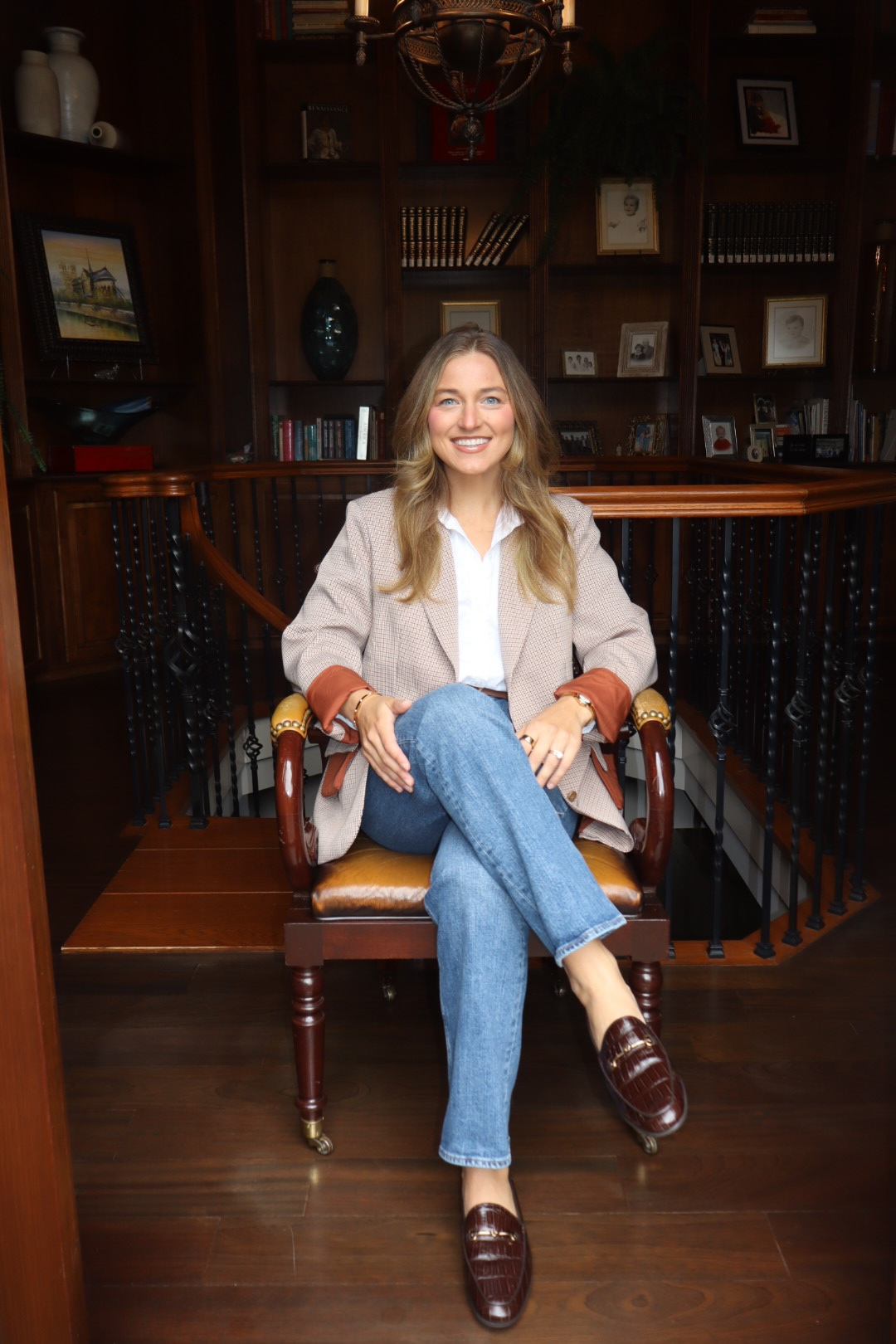
Today we’d like to introduce you to Grace Sallusti.
Grace, we appreciate you taking the time to share your story with us today. Where does your story begin?
Throughout my career, I’ve become increasingly interested not simply in what children learn, but in how they learn—and in the many factors that shape whether a child feels capable, engaged, and successful. That curiosity has guided me through different roles in education, with a particular focus on literacy and language development. I began my career as a middle school literacy teacher in Philadelphia and later earned my master’s degree in Reading, Writing, and Literacy from the University of Pennsylvania, along with my Reading Specialist certification. I am also trained in the Orton-Gillingham approach and earned a post-master’s certificate in English Language Learning, experiences that deepened my understanding of how differently students can process language, develop literacy skills, and respond to instruction.
As a military family, we have moved from state to state over the years, and each move has placed me in a different educational setting. Professionally, I have taught middle school literacy, supported multilingual elementary students, worked in early childhood education and educational leadership, and provided individualized reading intervention. My husband and I are also raising three very young children—a three-year-old, a two-year-old, and a three-month-old—which has given me an entirely new perspective on the relationship between families and the educators they trust to support their children.
Working across different school systems, developmental stages, and student populations—and now experiencing education from the perspective of a parent as well—has continued to shape the way I think about learning. Those experiences have reinforced for me that effective education requires both strong instruction and a genuine understanding of the individual learner.
When our family moved from Nashville to Virginia, I learned about Matt Aborn and Mindful with Children. I was immediately drawn to the company because Matt had built its educational philosophy around many of the ideas I had come to value through my own experiences with students. After more than twenty years in education and graduate study at the Harvard Graduate School of Education, Matt founded Mindful with Children around the understanding that meaningful learning requires us to look beyond academic performance alone. One of the ideas at the heart of the company is that children are “more than what they know,” and that immediately resonated with me.
Today, I serve as the Intake and Student Support Specialist at Mindful with Children. The role has allowed me to bring together so many different parts of my background—literacy, individualized instruction, family collaboration, and an interest in understanding the learner beyond what may initially appear on paper. It has also given me the opportunity to work alongside Matt within a model that reflects what I have increasingly come to believe throughout my career: meaningful educational support begins with truly understanding the individual child.
I’m sure it wasn’t obstacle-free, but would you say the journey has been fairly smooth so far?
I don’t think a career in education is ever an entirely smooth or linear road. As a military family, we have moved several times, which has meant leaving schools and communities I cared deeply about and rebuilding professionally in new places. While those transitions were challenging, they also gave me the opportunity to work across very different educational settings, age groups, communities, and student populations.
In retrospect, those varied experiences have become one of the most valuable parts of my professional development. Moving between different educational environments required me to continually adapt—to new school cultures, new communities, different approaches to teaching and learning, and students and families with very different experiences and perspectives. It taught me how important it is to build relationships with people whose backgrounds or experiences may look very different from my own, and to listen before assuming I understand what a student or family needs. It has also given me a much broader frame of reference for understanding learners. I have seen firsthand that two students of the same age, with similar academic concerns, can have entirely different strengths, motivations, challenges, and ways of engaging with learning.
One of the challenges I encountered throughout those experiences was seeing how difficult it can be to meet that level of individual need within the realities of a traditional school setting. Educators can be incredibly skilled and deeply invested in their students while also navigating limited time, large caseloads, established curricula, and many competing demands. Working within those environments taught me that what we see on the surface academically does not always tell us what is actually preventing a child from progressing.
Becoming a mother has broadened that perspective further and given me an even deeper appreciation for the trust families place in educators and the importance of treating parents as meaningful partners in their child’s education.
Looking back, the less linear parts of my career have given me a breadth of experience I could not have planned for. Working across developmental stages, educational environments, and communities has taught me to be adaptable, observant, and responsive—and, perhaps most importantly, to approach each new student and family with curiosity rather than assumption. I bring that perspective into my work at Mindful with Children every day.
Alright, so let’s switch gears a bit and talk business. What should we know about your work?
At Mindful with Children, our work is grounded in the understanding that academic challenges rarely exist in isolation. A student may come to us because they are struggling with reading, writing, mathematics, organization, executive functioning, or another academic area, but our first question is not simply, “What skill is missing?” We want to understand the larger picture: how the student approaches learning, what has and has not worked in the past, where frustration or disengagement may be coming from, and what conditions will allow that student to experience meaningful and sustainable growth.
My role as an Intake and Student Support Specialist allows me to be involved in that process from a family’s first conversation with us through the student’s ongoing work with their specialist. I conduct our initial family intakes, where I spend considerable time learning about the student’s academic history, strengths, challenges, interests, personality, motivation, learning preferences, and previous experiences with support. Together with the family, we establish individualized goals and develop a clearer picture of what meaningful progress would look like for that particular student.
From there, I work closely with Matt to thoughtfully pair the student with a specialist. Matt has assembled an incredibly talented group of educators with diverse areas of expertise, professional backgrounds, teaching styles, and personalities. Together, Matt and I consider the academic expertise a student needs, but we also think carefully about relational fit—who is most likely to understand, connect with, and appropriately challenge that individual student. We recognize that even an exceptionally qualified educator may not be the right fit for every learner, and I think that level of intentionality in the matching process is one of the things that really distinguishes Mindful with Children.
My role then continues after services begin. As the Student Support Specialist, I remain connected to the student’s work by overseeing their progress with the specialist, providing support as goals evolve, and maintaining ongoing communication with families. Each month, I connect directly with our specialists to understand what they are seeing in sessions—where a student is progressing, where challenges remain, what strategies are proving effective, and how the work is developing—and communicate those updates back to families. This creates continuity between the goals established during intake and the work taking place over time, while also giving us the opportunity to revisit goals and respond thoughtfully as a student’s needs evolve.
One of the aspects of my work I am most proud of is the continuity we provide for families. Parents often come to us after spending considerable time trying to understand what their child needs, and sometimes after other forms of support have not fully addressed the larger picture. Our goal is for families to feel supported and informed throughout the process—not only at the beginning, when goals are established and a specialist is selected, but as their child’s work continues and evolves. Because we are considering the whole child, growth can take many forms. It may be academic, but it may also look like greater confidence, stronger self-awareness, increased independence, improved organization, or a healthier and more productive relationship with learning.
My own background is primarily in literacy and language development. I am a certified Reading Specialist, trained in the Orton-Gillingham approach, and have advanced training in English Language Learning, so I bring a particular lens to students with reading, writing, and language-based needs. At the same time, one of the things I value most about Mindful with Children is the breadth of expertise Matt has brought together. No one educator is expected to be the right expert for every learner; instead, students can be connected with a specialist whose expertise and approach align with what they actually need.
Ultimately, what I appreciate most about the model Matt has developed is that success is not defined solely by an improved grade or completed assignment. Those outcomes certainly matter, but we are also paying attention to whether a student is becoming more reflective, strategic, confident, and independent. The goal is not to create dependence on support, but to provide the right support at the right time so that students gradually develop the skills and self-understanding to navigate challenges more independently. That, to me, is what makes this work so meaningful.
Let’s talk about our city – what do you love? What do you not love?
Because Mindful with Children serves families throughout the broader DMV area, I tend to think of our community less in terms of one specific city and more as the interconnected region we have the privilege of working within.
What I appreciate most about the DMV is the extraordinary diversity of its families, schools, and communities. Through Mindful with Children, I have the opportunity to work with families across Maryland, Washington, D.C., and Northern Virginia, and that exposes us to an incredible range of educational environments, perspectives, and needs. I find that diversity especially valuable in education because it continually challenges us to remain curious and responsive rather than assume that one approach will translate equally well across students, families, or schools.
If I had to identify a challenge of living and working in the DMV, it would probably be the pace of life here. Families are often balancing demanding professional schedules, rigorous school expectations, extracurricular activities, commutes, and family responsibilities all at once. That can create considerable pressure for both parents and students, and it is one of the reasons I think thoughtful support is so valuable. Sometimes the most productive thing we can do for a student is not add more to their plate, but help them develop the strategies to navigate what is already there more effectively.
In fact, one thing I consistently tell students during our intake sessions is that our job is to make their daily lives easier, not harder. We are not there simply to add another obligation to an already full schedule. We want the work happening in sessions to translate into a student’s everyday life—whether that means approaching an assignment with greater confidence, managing responsibilities more independently, or simply feeling better equipped to handle the demands of school.
Contact Info:
- Website: https://mindfulwithchildren.com/