



Today we’d like to introduce you to April Kelsey.
Hi April, we’d love for you to start by introducing yourself.
I’ve dreamed of being a writer since I was 5 years old. I spent my elementary and high school years writing poetry and short stories. When I got to college, I went into journalism. My journalism classes taught me so many valuable facets of the writing and editing process, but the environment was not the ideal fit for me. I switched my major to English Literature and graduated much happier with my degree.
Now, I faced a problem: how to land a writing job that wasn’t in journalism. I found an extremely low-paying, part-time gig writing educational articles for people’s websites. Around this time, I learned about copywriting for marketing and was instantly hooked. Copywriting offered everything I was looking for: creativity, variety of topics, application of skills, and the excitement of knowing each day would bring different challenges. Shortly thereafter, I found a job at an international nonprofit and worked my way up from Advancement Associate to Communications Strategist. By then, I was producing nearly all of the nonprofit’s marketing content and tracking its performance. I estimate that my work was responsible for raising about $20 million in the 8 years I was on staff—even during COVID.
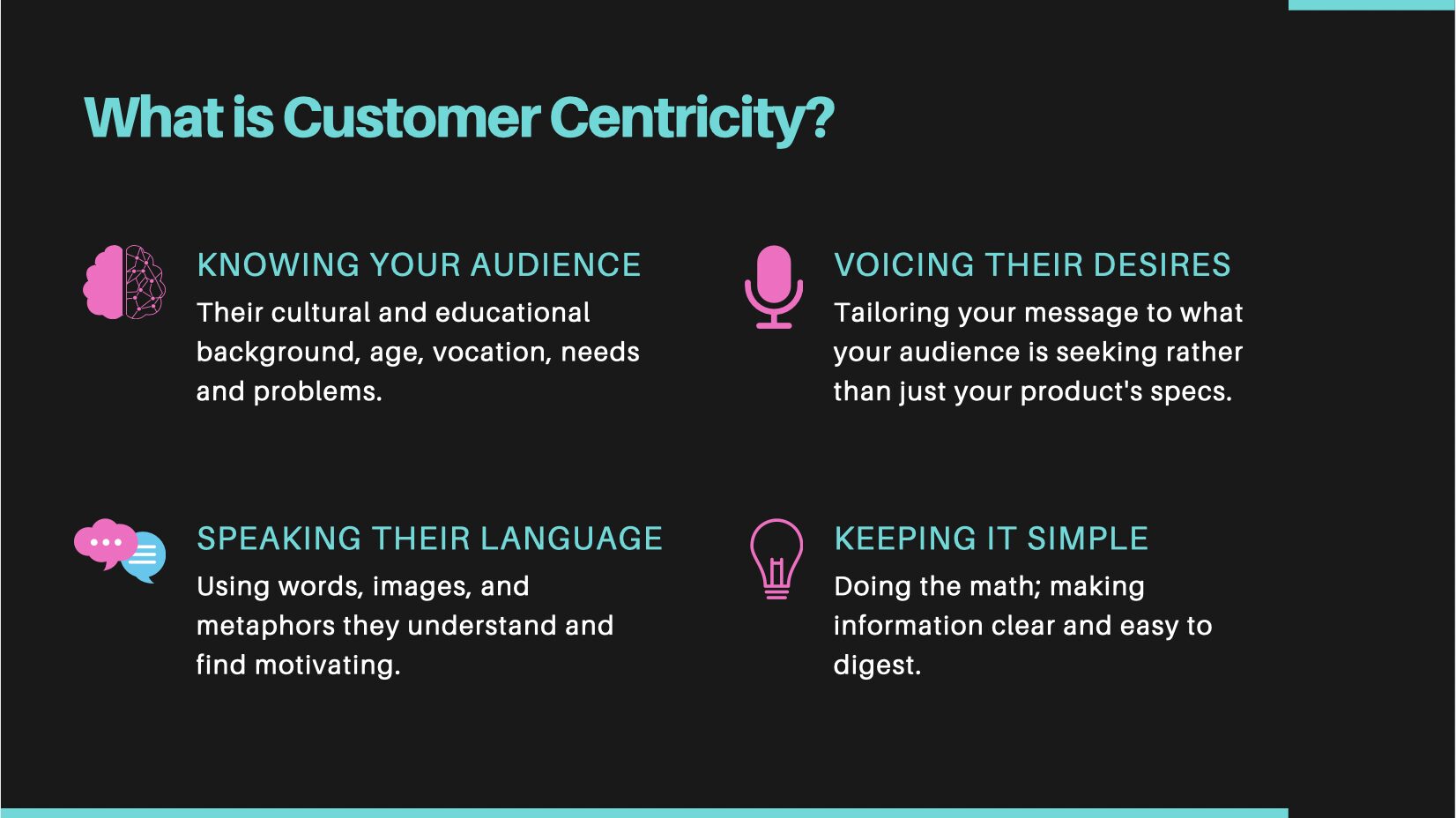
Once COVID passed, though, I was ready for a change. I resigned by job in April 2021 and founded Marketable Copy. During my time at the nonprofit, I had learned a lot about customer centricity, the act of centering the customer (or audience) in marketing communications. It was so effective, it worked like magic. I saw genuine joy and enthusiasm unfold, among both donors and staff, every time I applied it. Yet, very few organizations appeared to be using it, especially in the Fortune 500 space. Marketable Copy became my vehicle for bringing customer centricity back to marketing and corporate communications. And it goes beyond writing to include user experience design and content accessibility. If you consider that 25% of Americans have some kind of visual impairment, it becomes critical to have text displaying at the right size and contrast for people to understand your message. Colleagues occasionally tire of hearing me critique inaccessible text and designs, but it’s incredibly important. Companies constantly optimize for speed and efficiency; why wouldn’t they also optimize for reach and impact?
Nevertheless, due to the economic and technological disruption of the past few years, keeping a marketing business alive has been challenging. Many business owners think that using AI for marketing will accomplish their goals for free, and my work is anything but free. But as the saying goes, “You get what you pay for.” As part of my ongoing foray into the corporate world, I’ve been studying generative AI and learning how it functions. I’m fascinated by the linguistic aspects of the machine and its impact on syntax and meaning. So much of human communication, however, depends on shared context, body language, tone of voice, and symbology. In written form alone, language becomes leaky. And that’s exactly what we’re seeing with LLMs: a lot of leakage. The models drift, make up facts, disregard certain prompts, and prioritize rewards over outcomes. And that’s before you consider the ongoing updates deployed by AI companies and the models’ underlying mechanic of pattern recognition and replication—meaning, at best, they give you an average of all the marketing that’s been done in the past. If you’ve ever wondered why marketing seems so bland these days, that’s a big reason why.
Aside from AI, I find myself being drawn more and more into graphic and brand design work. I’ve always loved art and have dabbled in painting, sewing, pottery, sculpture, and beading. Building brand identities that match tone of voice with color and style feels natural and exciting. So Marketable Copy is moving away from pure copywriting into more brand-focused work. At the 5-year mark of my solo agency’s existence, it feels like the right move.
Can you talk to us a bit about the challenges and lessons you’ve learned along the way. Looking back would you say it’s been easy or smooth in retrospect?
One of my first clients was a functional programming firm helping its clients build the technology behind blockchain and cryptocurrency. The firm grew by 1,200% in both staff and clients from 2022 to 2023. It was doing so well that the founder paid for all its programmers and contractors to stay at a resort in Costa Rica for a week. We talked of gathering in Malta the following year. Then, the blockchain industry collapsed in the wake of the FTX scandal. Clients vanished overnight, leaving invoices unpaid. The firm had to pause their marketing services and lay off nearly all of its programmers. It pivoted to acquiring government contracts just in time for the Trump administration to cut that funding, too.
I now have a client in the change management space. If you’ve seen the news, all the big change management firms, like McKinsey and EY, are laying off consultants left and right. That means work is slow and uneven for everybody. Some weeks, I’m allotted a full 40 hours to work on my client’s marketing. Other weeks, I get five.
When I founded Marketable Copy in 2021, I pursued a certification in user experience (UX), thinking it would allow me to offer more to my clients. It did, and I’m so glad I went through with it. But shortly after earning it, the UX industry crashed too, wiping out nearly all pathways for me to pivot to a career in UX if necessary.
Just working my way up to the corporate level has been extremely challenging. Many companies require marketing creatives to have ad agency experience and a portfolio of managing 360 campaigns for major brands to be considered for hiring. That’s an incredibly high bar for anyone who entered the market without internships and industry connections.
Thanks for sharing that. So, maybe next you can tell us a bit more about your business?
I specialize in brand and website messaging. What sets me apart is the intention I bring to it. When a client hires me, I want to know everything about their customers and business. What is their purpose for being? What are their short- and long-term goals? What challenges do they need to overcome to get there? How can I help them win?
I’m reading all of their customer reviews. I’m auditing their website. I’m visiting all their competitors’ websites and social media pages. I’m researching the top voices in the industry to learn their concerns. I want to know everything. A lot of agencies now use AI to automate this process, having it synthesize customer profiles, develop a strategy, and draft the content. I don’t. Instead, I use AI as a sounding board as I iterate on phrasing and positioning. The process is slower than automation but far more thorough and effective.
I am most proud of two accomplishments. The first is producing an internal gamification campaign to introduce a company’s staff to their new learning repository. I set it up as a digital scavenger hunt so employees would have to look through the files and screenshot the hidden icons. Setting it up was incredibly tedious, but the campaign worked beautifully, with over 80% participation. My change management client turned the campaign into a case study and a service offering.
The second accomplishment is giving my clients confidence and enthusiasm in their marketing. To hear them say, “Yes, this is what we’ve been missing!” or “I didn’t know we could sound this professional” never fails to warm my heart. That’s why I founded this business, after all.
We all have a different way of looking at and defining success. How do you define success?
I recently attended a scholar’s reception at Old Dominion University and heard the Dean of Arts and Letters speak about “choosing the path that feels like freedom.” That’s exactly how I’ve approached my career at every step. It’s a both a privilege and a risk to choose that path. In my growing up, people often implied that going into a creative field was a mistake, that achieving success would be difficult and unlikely. They weren’t mistaken about the level of difficulty. But they underestimated its effect on my life force. We all have to work a certain number of hours per week. How many people sit in front of their computers every day and think, “I can’t believe I get to do this”? Not nearly enough in my estimation. But I do. And it’s hard to express how valuable that is.
Pricing:
- Branding package – starts at $6,000
- Website package – starts at $5,000
- Speaking or training – $200 per hour
Contact Info:
- Website: https://marketablecopy.com
- Instagram: https://www.instagram.com/marketablecopy/
- Facebook: https://www.facebook.com/MarketableCopy
- LinkedIn: https://www.linkedin.com/company/marketable-copy/